OEM t-shirts Pricing Guide: What Affects the Cost Per Unit?
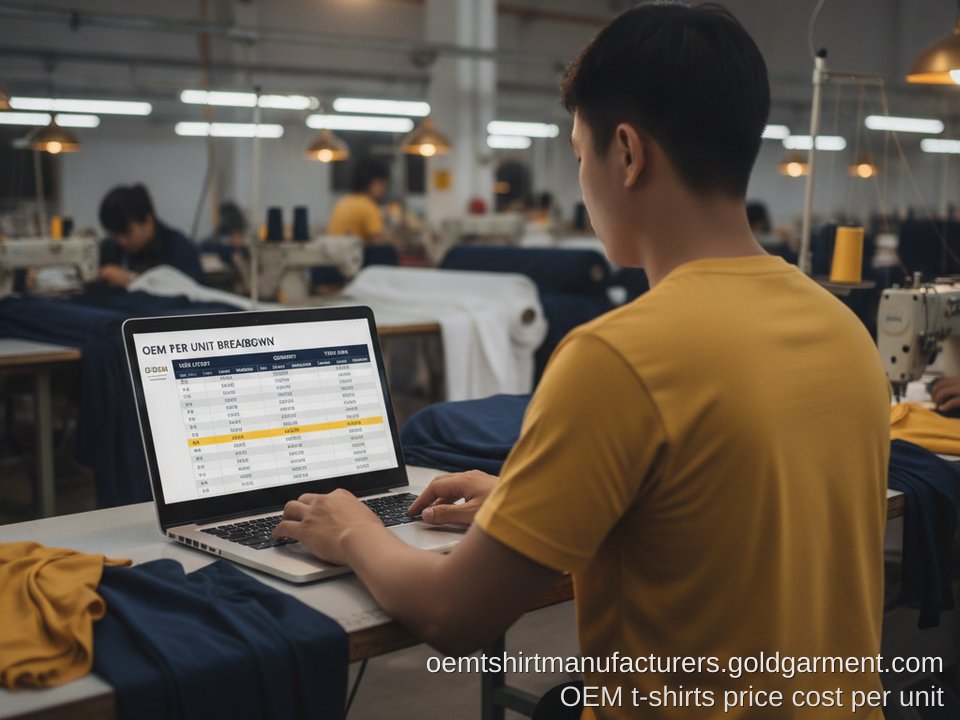
OEM T-Shirts Pricing Guide: What Affects the Cost Per Unit?
When budgeting for custom apparel, understanding the factors that influence the OEM t-shirts price cost per unit is crucial for making informed decisions. As a professional t-shirt manufacturer, Gold Garment, based in Ho Chi Minh City, Vietnam, we aim to provide clarity on how your final quote is determined. This guide will break down the key elements that contribute to the overall cost, helping you navigate the complexities of bulk t-shirt production.
Our goal is to empower brands, startups, and businesses to secure high-quality custom apparel at competitive rates. By demystifying the pricing structure, you can better communicate your needs to manufacturers like us and ensure you're getting the best value for your investment. The t-shirt OEM cost is not a single figure but a composite of various production stages and material choices.
Key Factors Influencing OEM T-Shirts Price Per Unit
Several variables play a significant role in determining the final OEM t-shirts price cost per unit. From the foundational fabric choices to the intricate details of embellishments, each decision impacts the overall cost. Understanding these elements will allow you to optimize your design and production strategy for the best possible outcome.
1. Fabric Choice and Quality
The foundation of any t-shirt is its fabric, and this is a primary driver of cost. Different materials offer varying levels of comfort, durability, and aesthetic appeal, each with its own price point. For instance, 100% premium cotton, particularly organic or Pima varieties, will command a higher price than standard cotton blends or basic polyester.
The weight of the fabric, measured in grams per square meter (GSM) or ounces per square yard, also influences cost. Heavier fabrics generally require more material and can therefore be more expensive. For a comprehensive understanding of the materials available, our OEM t-shirts Fabric Guide offers detailed insights into cotton, polyester, tri-blend, and performance materials.
2. Design Complexity and Print Method
The intricacy of your design and the chosen printing method are significant cost determinants. Simple, single-color designs are typically less expensive to produce than multi-color graphics or complex photographic prints. The printing technique itself plays a vital role in the custom OEM t-shirts pricing.
Common methods include:
- Screen Printing: Ideal for larger runs and solid colors, it's cost-effective for simple designs but can become expensive with many colors.
- DTG (Direct-to-Garment): Excellent for full-color, detailed designs and smaller runs, but can be more costly per unit for very large quantities.
- Heat Transfer Vinyl (HTV): Suitable for specialty effects and smaller batches, but can add to the cost per unit.
- Embroidery: Offers a premium look and feel but is generally more expensive than printing, especially for larger designs.
3. Color of the T-Shirt
While it might seem minor, the color of the t-shirt can sometimes affect the price. White t-shirts are often the most economical base. Darker colors, especially vibrant or deep hues like black, navy, or red, may require more ink or a special underbase to achieve opacity, potentially increasing the cost slightly.
This is particularly true for screen printing, where achieving a vibrant color on a dark garment often necessitates an additional layer of white ink. This extra step in the printing process contributes to the overall t-shirt OEM cost.
4. Garment Style and Features
The style of the t-shirt itself has a direct impact on its base cost. Basic crew necks are typically the most affordable option. More specialized styles, such as V-necks, scoop necks, raglan sleeves, or performance-fit shirts, often involve more complex patterns and construction, leading to a higher price point.
Additional features like custom labels, specific stitching, extra buttons, or unique collar designs also add to the manufacturing complexity and, consequently, the OEM t-shirts price cost per unit. For a detailed overview of available styles, consult our T-Shirt Styles Guide.
5. Quantity of the Order
Perhaps one of the most significant factors in reducing the OEM t-shirts price cost per unit is order volume. Manufacturers, including Gold Garment, benefit from economies of scale. The higher the quantity of t-shirts produced in a single run, the lower the cost per piece becomes.
This is due to the spread of setup costs (like screen preparation or machine calibration) over a larger number of items. Our minimum order quantity (MOQ) is 100 pcs per style, which allows for accessible bulk production for many brands. Understanding MOQs is vital, as detailed in our Minimum Order Quantity for OEM t-shirts guide. The advantage of ordering in bulk from a Vietnamese manufacturer like us can be seen through our Gold Garment factory-direct pricing, which is designed to be competitive globally.
6. Embellishments and Finishing Touches
Beyond basic printing, any additional embellishments will increase the overall cost. This can include things like custom neck labels, woven tags, embroidery, puff print, metallic inks, or unique packaging. Each of these adds a layer of labor and material cost to the production process.
The complexity and number of embellishments directly correlate with the final t-shirt OEM cost. For example, a t-shirt with a printed logo, a woven neck label, and a small embroidered detail will be more expensive than a plain printed t-shirt.
7. Manufacturing Location and Labor Costs
The geographical location of the manufacturing facility plays a role in labor costs and operational expenses. Countries with lower labor wages can offer more competitive pricing for bulk apparel production. Vietnam, where Gold Garment is located, offers a strong advantage in this regard, providing skilled labor at competitive rates.
This allows us to offer attractive bulk tshirt price Vietnam options without compromising on quality. Our extensive experience as a Gold Garment corporate t-shirt manufacturer Vietnam has honed our processes to maximize efficiency and cost-effectiveness for our international clients.
8. Shipping and Logistics
While not directly part of the manufacturing cost per unit, shipping expenses are a critical component of the total landed cost for your order. International shipping rates can vary significantly based on destination, shipping method (air vs. sea freight), and current fuel costs. Manufacturers typically provide FOB (Free On Board) pricing for the goods, with shipping costs calculated separately.
It's important to factor these logistics into your overall budget to get a true picture of the final expense. We offer worldwide shipping to ensure our clients across the USA, Europe, Australia, and Southeast Asia can receive their orders efficiently.
Understanding OEM vs. Private Label Pricing
It's worth noting the distinction between OEM (Original Equipment Manufacturer) and private label production. While both involve manufacturing garments for other brands, the level of design input and branding can differ, sometimes influencing pricing. In an OEM model, the client often provides detailed specifications, while private label might involve selecting from existing designs and adding their brand. For a deeper dive into these models, refer to our article on OEM vs Private Label OEM t-shirts Manufacturing.
Frequently Asked Questions
Q: How can I get the best OEM t-shirts price cost per unit?
A: To achieve the best OEM t-shirts price cost per unit, focus on ordering in larger quantities, simplifying your design and printing requirements, choosing cost-effective but quality fabrics, and working with manufacturers who offer competitive factory-direct pricing, like Gold Garment in Vietnam.
Q: Does the minimum order quantity (MOQ) significantly impact the price per unit?
A: Yes, the MOQ is a critical factor. While our MOQ is 100 pcs per style, which is relatively low, ordering quantities well above the MOQ will significantly reduce the cost per unit due to economies of scale and the distribution of setup costs over more items.
Q: Are there hidden costs I should be aware of when calculating t-shirt OEM cost?
A: Beyond the per-unit manufacturing cost, be mindful of potential costs for custom samples, artwork setup fees (if applicable), shipping and import duties, and any additional embellishments or special finishing touches you request. Always ask for a detailed breakdown from your manufacturer.
Q: How does working directly with a manufacturer in Vietnam affect the bulk tshirt price Vietnam?
A: Working directly with a manufacturer in Vietnam, such as Gold Garment, eliminates intermediaries, leading to more competitive factory-direct pricing. This also provides direct communication, ensuring your specifications are met accurately and efficiently, thereby optimizing your overall production budget.
Understanding these pricing factors is key to a successful custom t-shirt production run. We encourage you to reach out to us to discuss your specific project needs and receive a tailored quote.
📩 Request a Free Quote — Response Within 5 Minutes
🌎 Website: oemtshirtmanufacturers.goldgarment.com
Factory-direct pricing · MOQ from 100 pcs/style · Sample development · Worldwide shipping
.jpg)
.jpg)
.jpg)
Nhận xét
Đăng nhận xét